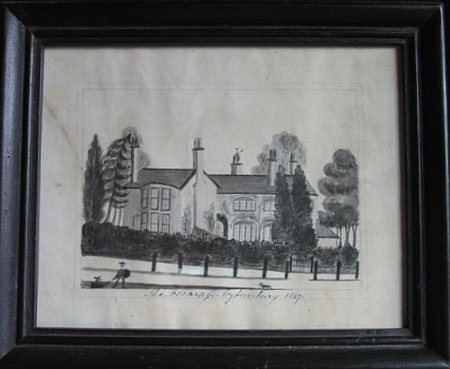
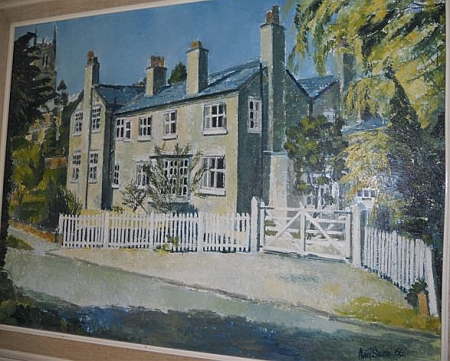
at Lumburn, Dist of Tavistock, DEV, ENG

G L

Click on the G or L link above for maps, and zoom in for a satellite, or aerial view.

The picture below is believed to have hung on my grandmother's wall, so I initially believed it to be a place associated with the Rowe family. Subsequent research showed that the millers of the family were the Dawe side instead, the family of Isaac Smith Dawe populating a rather large number of the mills of the area. So it seemed highly likely to be a Dawe family outside their mill.
However, on closer examination, this photo proves rather problematic.
It surely cannot have been taken before the 1860s, yet by then, the Dawe family no longer had any ties with the Lumburn Mill, having either died, or emigrated to Australia, or working on other mills in the area instead.

So, who are the people in this photograph, and when was it taken?

The following is my attempt to rationalise who was where, and possibly identify who is shown in the Lumburn Mill photograph.
Isaac Snr had been a miller at Lamerton, Mill Hill, (1814), and Lifton (1819).
When Isaac Snr died in Plymouth Dec 1840, the informant was son Nathaniel, a miller living in a Bedford Cottage, Tavistock.
1818-1821: Isaac Smith Dawe (Jnr) miller at Mill Hill
1823-41: Isaac Jnr at Newton Mill;
1841: Richard miller at Ermington Mill; Isaac Jnr at Newton Mill; Nathaniel miller in Plymouth Charles; William miller at Upcot Mill, Sheepwash; Thomas servant for James Turner, miller at Newland Mills, North Tawton;
1847: Isaac Jnr wrote will at Lumburn;
1851: Richard miller at Huckworthy Bridge, Sampford Spiney; Isaac Jnr miller at Lumburn; Nathaniel miller in Plymouth Charles; Joan & husband Abraham Bidgood miller at Newton; William miller at Trelubis, Wendron, Cornwall; Thomas miller at Powder Mill, Lydford
1861: Richard miller at Hayle Foundry, Phillack, Redruth, Cornwall; Nathaniel miller in East Stonehouse; Joan & husband Abraham Bidgood (mine labourer) at Newton Old Mill; William miller at Trelubis, Wendron, Cornwall; Thomas milller at Cockingford, Widecombe
1862: Joan Bidgood nee Dawe died at Lumburn
1871: Richard miller at Tipton Mills, Wiggaton, Ottery St Mary; William miller at Trelubis, Wendron, Cornwall; Thomas milller at Cockingford, Widecombe

The next generation, children of Isaac Smith Dawe Jnr:
1851: David millwright with his uncle Nathaniel in Plymouth Charles (and emigrated to Melbourne 1856; Isaac Jnr at Lumburn, enumerated directly after his father (and emigrated to Tasmania between 1855 and 1857)

So by 1862 the last of the Dawe family direct associations with Lumburn had ceased as far as I can tell.

By 1861 the miller at Lumburn was Charles Hoyle with no (as yet) known connection to the Dawe family, although there is a very remote connection to the Rowe family via Hamley and Fuge and Australia, which is how come this discussion is even taking place.

Check out a modern version of the mill from the East (Tavistock) side on Geograph, which caption overcomes one of my initial problems with identifying this set of buildings as the mill when I was exploring in Aug 2006, no obvious water source.

My current theory is that it was a couple of the Dawe women, possibly with the chap in the top hat, coming back to see the mill, sometime in the 1860s, and that the miller and the two younger women behind the fence are therefore Hoyle family.

 
Search this site (uses FreeFind)
  • Whenever I hear anyone arguing for slavery, I feel a strong impulse to see it tried on him personally.

    Abraham Lincoln
  • My formula for living is quite simple. I get up in the morning and I go to bed at night. In between, I occupy myself as best I can.

    Cary Grant
  • Analyzing humor is like dissecting a frog. Few people are interested and the frog dies of it.

    E. B. White
  • I'm living so far beyond my income that we may almost be said to be living apart.

    e. e. cummings
  • What then is time? If no one asks me, I know what it is. If I wish to explain it to him who asks, I do not know.

    — Saint Augustine
  • Don't go around saying the world owes you a living. The world owes you nothing. It was here first.

    Mark Twain
  • If a man does not keep pace with his companions, perhaps it is because he hears a different drummer.

    Henry David Thoreau
  • If two things look the same, look for differences. If they look different, look for similarities.

    John Cardinal
  • In theory, there is no difference. In practice, there is.

    — Anonymous
  • Facts are stubborn things; and whatever may be our wishes, our inclinations, or the dictates of our passion, they cannot alter the state of facts and evidence.

    John Adams
  • People who like this sort of thing will find this the sort of thing they like.

    Abraham Lincoln
  • History - what never happened described by someone who wasn't there

    — ?Santayana?
  • What's a "trice"? It's like a jiffy but with three wheels

    — Last of the Summer Wine
  • Inside every old person is a young person wondering what happened

    — Terry Pratchett
  • I'll be more enthusiastic about encouraging thinking outside the box when there's evidence of any thinking going on inside it.

    — Terry Pratchett
  • .. we were trained to meet any new situation by reorganising; and a wonderful method it can be for creating the illuson of progress

    — Petronius (210 BC)
  • The time we have at our disposal every day is elastic; the passions that we feel expand it, those that we inspire contract it; and habit fills up what remains

    — Proust
  • You cannot help men permanently by doing for them what they could and should do for themselves.

    William J. H. Boetcker
  • Only a genealogist thinks taking a step backwards is progress

    — Lorna 1992
  • No man ever believes that the Bible means what it says: He is always convinced that it says what he means.

    — George Bernard Shaw
  • A TV remote is female: It easily gives a man pleasure, he'd be lost without it, and while he doesn't always know which buttons to push, he just keeps trying.

    — Anon
  • Hammers are male: Because in the last 5000 years they've hardly changed at all, and are occasionally handy to have around.

    — Anon